

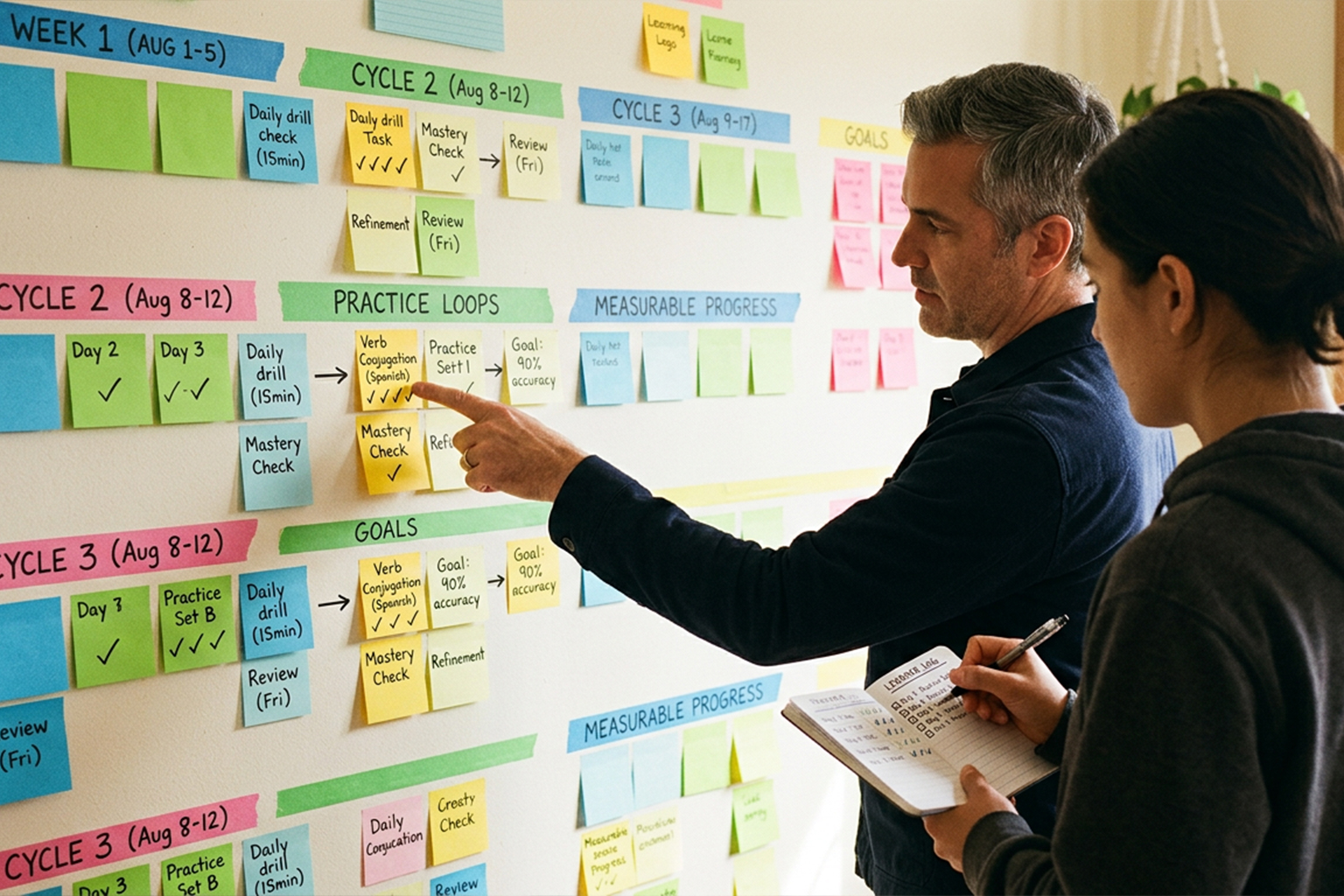
Short learning cycles break large goals into focused, manageable projects.
They make daily decisions clearer and reduce wasted effort across topics.
This article shows how to define cycles, build practice loops, and measure progress.
Use these steps to turn curiosity into steady competence over months.
Define clear short-cycle goals
Start by choosing a narrow outcome you can achieve in one to four weeks, such as mastering a specific subskill or completing a small project. Timeboxing forces trade-offs: decide what you will leave out and which constraints you will keep. Capture a measurable success criterion so you know when the cycle is complete and can move on. Clear goals keep motivation steady and reduce the friction of choosing what to practice each day.
Set realistic scope by estimating effort and scheduling regular checkpoints. Treat the cycle as an experiment with a defined feedback loop.
Design repeatable practice loops
Create a daily or weekly routine that mixes active practice, reflection, and spaced review. Use short sessions focused on the most essential tasks; repeated, deliberate attempts beat long unfocused study. Incorporate a simple reflection at the end of each session to note one improvement and one obstacle. Over multiple cycles, these tiny iterated changes compound into meaningful progress.
Keep tools and materials minimal so starting a session is frictionless. Consistency wins over intensity for long-term growth.
Track progress and adjust rapidly
Choose two to three indicators that reflect real improvement, such as completion rate, error reduction, or task time. Record them in a compact log and review results at the end of each cycle to decide whether to continue, scale, or pivot. Small, frequent adjustments prevent wasteful escalation and help you discover which practices yield the best returns. Objective tracking also clarifies when to graduate from a cycle and plan the next learning target.
Use the data to refine future cycles and preserve what works. Treat setbacks as signals to tweak scope or technique rather than reasons to abandon the process.
Conclusion
Short cycles make ambitious learning practical by limiting scope, enforcing discipline, and enabling rapid feedback.
When you design repeatable practice loops and track simple indicators, momentum builds naturally.
Start small, iterate often, and let these cycles turn modest effort into lasting skill growth.