

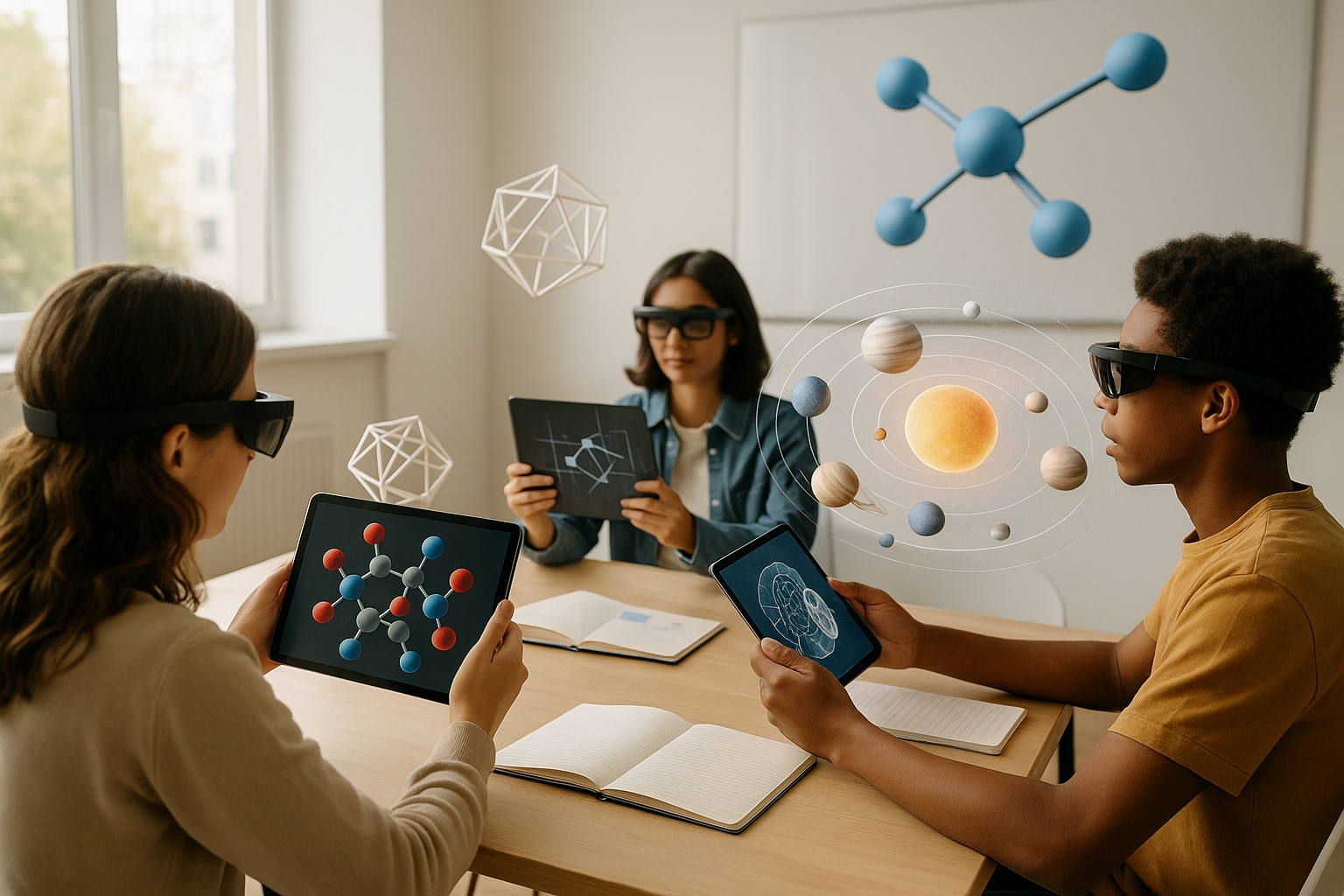
Augmented Reality (AR) is quickly becoming a powerful tool in STEM education, reshaping how students explore science, technology, engineering, and math. By blending digital elements with the real world, AR creates interactive, visual learning experiences that make complex concepts easier to understand. Instead of relying solely on textbooks or lectures, students can now manipulate 3D models, visualize abstract ideas, and participate in immersive problem-solving activities. As AR technology advances, it promises to make STEM learning more engaging, accessible, and effective.
Making Complex Concepts Easier to Understand
STEM subjects often involve abstract ideas that are challenging to grasp through traditional methods. AR brings these concepts to life by overlaying digital models onto physical environments. Students can explore the structure of a molecule, observe mathematical patterns, or interact with engineering prototypes in real time. This hands-on visualization helps deepen understanding and supports different learning styles.
Enhancing Engagement and Curiosity
AR transforms passive lessons into exciting, interactive experiences. Whether dissecting a virtual frog, exploring the solar system, or simulating chemical reactions, AR encourages curiosity and active participation. This level of engagement not only boosts motivation but also helps students retain information more effectively. When learning feels dynamic and immersive, STEM subjects become more approachable and enjoyable.
Supporting Collaboration and Problem-Solving
AR tools often include multi-user features that allow students to collaborate on virtual experiments or engineering challenges. Working together in shared augmented environments fosters teamwork, communication, and creative problem-solving — essential skills for STEM careers. These interactive sessions mirror real-world scientific collaboration, helping students develop both technical and interpersonal abilities.
Increasing Accessibility to High-Quality Resources
Many schools face budget or resource limitations that make it difficult to provide hands-on STEM experiences. AR bridges this gap by offering virtual labs, simulations, and models that replicate real equipment and environments. Students gain access to high-quality learning materials without the cost or safety concerns associated with physical labs. This increases equity and ensures that more learners can benefit from advanced STEM education.
Conclusion
Augmented Reality is revolutionizing STEM education by making learning more visual, interactive, and collaborative. By simplifying complex concepts, enhancing engagement, and expanding access to valuable resources, AR empowers students to explore STEM subjects with confidence and creativity. As AR becomes more integrated into classrooms, it will continue shaping a new generation of innovative thinkers and problem solvers.