

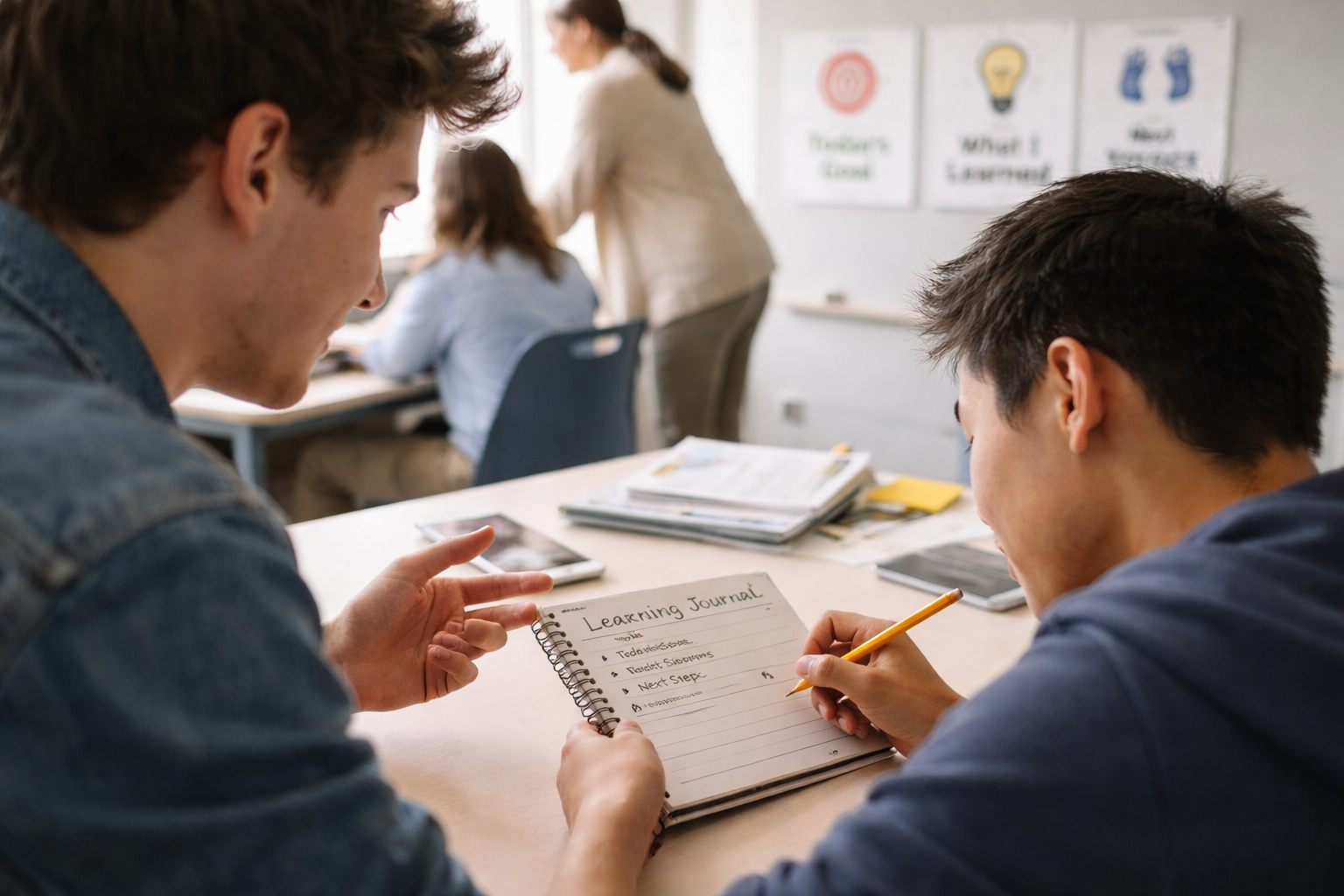
Reflection helps students connect daily tasks to deeper learning goals.
When routines make reflection predictable, habits form more quickly.
This article outlines simple classroom practices that embed reflection into instruction.
Teachers can use these routines with minimal prep and measurable results.
Why reflection matters
Reflection shifts attention from completion to meaning, encouraging metacognitive awareness.
Students who regularly articulate what they learned and how they learned become better at planning and monitoring future work.
Reflection also supports emotional regulation, helping learners recognize challenges and celebrate progress.
These outcomes translate into increased engagement and improved retention over time.
Practical routines to implement
Start with a daily five-minute wind-down where students answer two focused prompts: What did I learn? What will I try next?
Use exit tickets, learning journals, and brief peer debriefs to vary the format and keep responses fresh.
Integrate visual prompts like reflection anchors or sentence stems to support learners who need structure.
Rotate responsibility so students sometimes design prompts or summarize a peer’s reflection.
- Five-minute end-of-class prompts.
- Weekly learning journals with one self-assessment.
- Peer reflection pairs or triads for dialogue.
- Student-created reflection questions and rubrics.
These routines are small by design but powerful when applied consistently.
They require little time but yield clearer student direction and teacher insight.
Measuring impact and adapting
Collect samples of reflections to identify patterns in misconceptions or strategy gaps.
Use short rubrics to track growth in metacognitive language and goal specificity.
Survey students periodically about which routines feel most useful and why.
Adjust prompts, timing, and group structures based on this evidence to maintain relevance.
Classroom examples
In a science unit, students write a brief reflection about the experiment, noting one procedural change they would try next time and one concept that surprised them.
During a literature circle, each student records a sentence about how a character’s choice changed their understanding and pairs up to compare insights.
In math, quick reflections after problem sets can highlight strategies that worked, common errors, and steps for targeted practice.
These concrete examples show how reflection can be integrated across subjects without redesigning large parts of a curriculum.
Common challenges and tips
Time pressure and initial resistance are common, so begin with micro-reflections and build expectations slowly while celebrating early wins.
Provide models and exemplar responses to clarify what meaningful reflection looks like for different learners and proficiency levels.
Use technology selectively — digital journals can streamline collection and analysis, but paper prompts often feel more immediate for younger students.
Keep routines flexible; allow options for oral reflection, sketching, or brief recordings to honor diverse expression styles.
Conclusion
Reflection routines are a practical lever for deeper learning.
Start small, be consistent, and iterate based on evidence.
Over time, these practices cultivate independent, thoughtful learners.